My next stop on the winter seminar circuit is the Springfield Sportsmen's Show at the Big E in Springfield, MA. The show will be running Feb. 21, 22, and 23. Check out the website here for more information.This is a massive show in a huge venue. It's got everything "outdoors" for the hunter, fisherman and general outdoor person. It's also very family friendly, and usually draws a big, loyal crowd who return year after year.
I will be at the show doing seminars on Saturday, Feb. 22. As of right now, the seminar times are not set, but they should be posted on the website prior to the show's start. I will be doing my carp fishing seminar titled Seasonal Strategies for Carp Fishing. I'll also be doing this year's saltwater seminar titled Stripers, Blues and Albies: A Multi-Species Approach. I did both seminars at the New England Fishing Expo at Boxborough, MA, last week, and both were very well received.
Hope to see some of my followers at the show!
Friday, January 31, 2020
Tuesday, January 14, 2020
New Fishing Seminar to Debut at New England Fishing Expo, Boxboro, MA
My latest saltwater seminar that I'll be running this winter at many of the big outdoor shows is called "Stripers, Blues and Albies, A Multi-Species Approach". I wanted to do a show this year that dealt with more than just stripers since many of today's saltwater fishermen are doing just that ....fishing for whatever is the best bet. The seminar is in three segments and I will talk about some of the best strategies to target these "Big 3" species. I've got some great video footage of some wild blitzes and have all new photos that were taken in 2019. I think this will be a hit with the show goers.
My first stop in running this seminar will be at the New England Fishing Expo at the Boxboro Regency in Boxboro, MA. I'll be doing the seminar on Saturday, Jan. 25 at 5:00 PM in the Seminar Room. For those who don't know, this is the old Worcester Show, but it has been completely revamped as a pure fishing show. I've been there in the last few years, and it keeps getting bigger and better! It also boast about the best line-up of freshwater and saltwater seminar speakers of any show that I've ever been to.
Note that I will also be there on Sunday at 11 AM to present my newest carp fishing seminar titled "Seasonal Strategies for Carp".
Hope to see some of my followers this year at the New England Fishing Expo.

My first stop in running this seminar will be at the New England Fishing Expo at the Boxboro Regency in Boxboro, MA. I'll be doing the seminar on Saturday, Jan. 25 at 5:00 PM in the Seminar Room. For those who don't know, this is the old Worcester Show, but it has been completely revamped as a pure fishing show. I've been there in the last few years, and it keeps getting bigger and better! It also boast about the best line-up of freshwater and saltwater seminar speakers of any show that I've ever been to.
Note that I will also be there on Sunday at 11 AM to present my newest carp fishing seminar titled "Seasonal Strategies for Carp".
Hope to see some of my followers this year at the New England Fishing Expo.

Sunday, January 12, 2020
Loading Up
 |
| I've been tying up a storm in my basement. I think bucktail jigs will be hot tickets again this year, like always, for stripers. This is a lure you can easily make yourself. |
1. Bucktail jigs- I caught a lot of stripers last year on bucktail jigs. They became my go to lures most days in the fall. They also are great for catch-and-release fishing. I make all my own bucktail jigs. I really like both the spire point jigs and flat head jigs. If you are looking for the molds for these, check out Do-It Molds. When I'm going with a big jig, the spire point in 1, 1 1/2 and 2 oz. sizes are the ticket. When I'm fishing the bucktail jig off a float, I like the smaller flathead in a 3/8 or 1/2 oz size. All my jigs have white heads, white bucktail and are tied with red thread.
2. Topwater plugs- I'm stocking up on Rebel Jumpin Minnows in a bone color. These inexpensive spook type plugs were the hottest surface lures last year in Gansett Bay for stripers and bluefish in the summer and fall. I suggest changing out the hooks on these plugs to VMC 4X.
3. Cocahoes- I've ordered a bunch of these paddle tail lures in a glow/chartreuse tail color. I like the Queen or 4 inch model. Plain white and plain glow also work well. They were real hot along the oceanfront last year in both the spring and fall for stripers. Again, great for catch-and-release when mounted on a single hook jighead.
4. Big stuff for the Canal- I bought a bunch of 9 inch Sebile Magic Swimmers in a ghostescent color. These has been the hottest plugs in the Canal for big fish in the last few years. You can get them now, but come July, good luck finding any. I've also bought several Guppy pencil poppers, the topwater lure that proved to be my best last year. They come in various sizes. The best size will be determined by what your outfit can throw. I like the Jobo Junior in a pearl or Ghost mackerel color in a 3 oz. size.
Wednesday, January 8, 2020
Circle Hook Regulation Coming to MA in 2020. RI to Follow in 2021
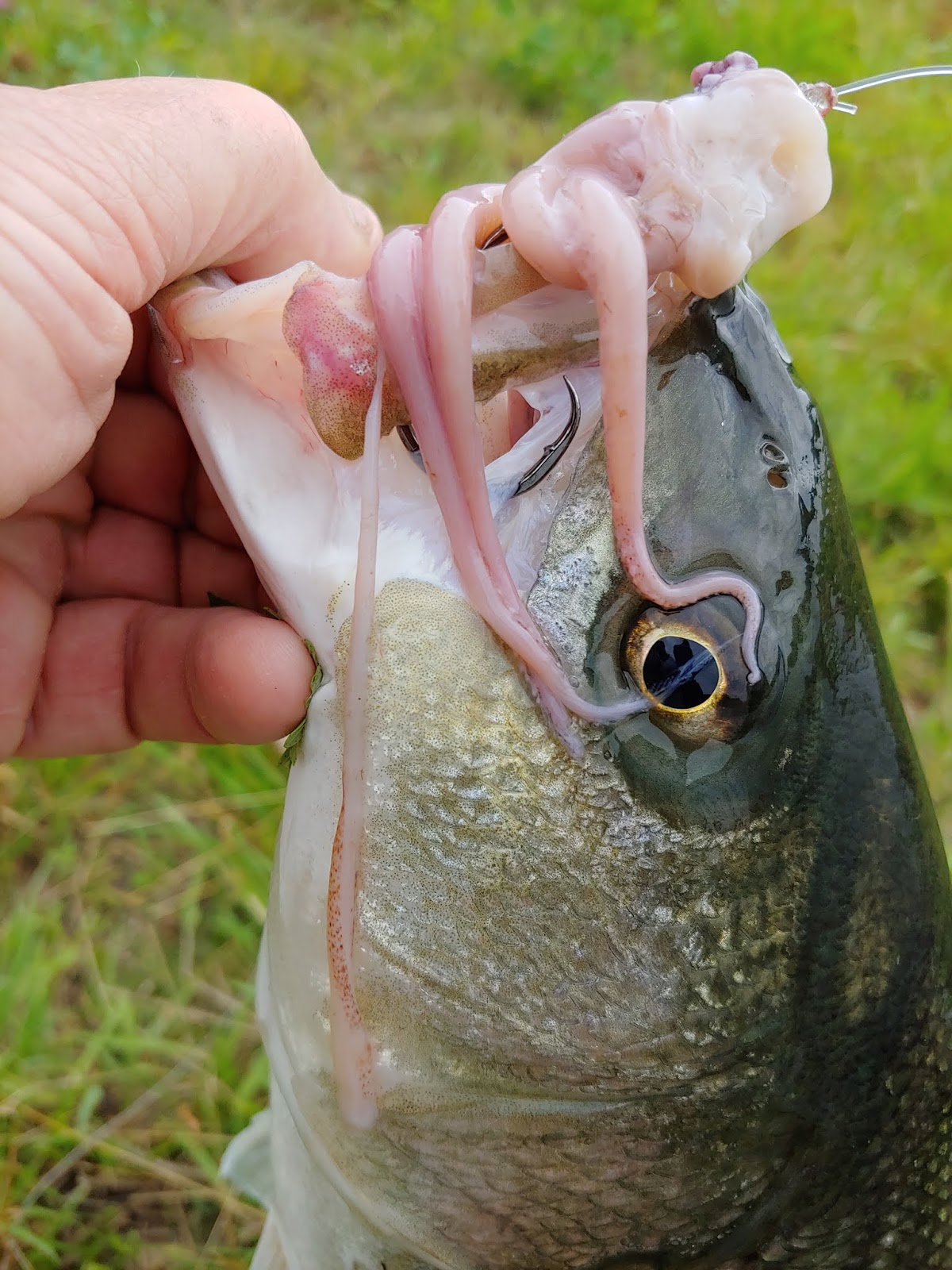 |
| In this case, my circle hook did just what it was intended to do as it hooked this small keeper right in the lip. The fish was released in good shape. |
Here is a copy of the MA regulation:
Effective next year (2020), recreational anglers not fishing aboard for-hire vessels will be required to use inline circle hooks when fishing for striped bass with whole or cut natural baits. This will include fishing with whole or cut natural baits while in possession of striped bass as well. This circle hook mandate will not apply to natural baits attached to an artificial lure to be trolled, jigged, or casted and retrieved (e.g., tube and worm). Nor will the mandate apply to any natural bait affixed to a treble hook and fished using the snag and drop technique. A hook is considered to be an in-line circle hook only if it is manufactured so the barb of the hook is in-line with the shank and bend of the hook and is turned perpendicularly back to the shank to form a circular or oval shape.
The above law answers many of the questions I had and doesn't address some. Here are just a few of those questions and how I interpret this:
*How about offset circle hooks? No good
*Snagging pogies on a treble hook and letting them drop? That seems to be ok to do.
*Fishing with squid strips on a jig? ok
*Using a rigged eel with traditional hooks? not sure
*Use of eel skin plugs with a treble hook? ok
*Use of live eels? Need to use a circle hook.
*Fishing for blues, black sea bass or other fish with traditional bait hooks? not sure
So, you can see there are some gray areas here. We might see further clarification of this regulation in the coming months.
Wednesday, December 25, 2019
Merry Christmas and Happy Holidays
 |
| The sun sets on another fishing year here in RI. Merry Christmas to all my fishing friends and to all the wonderful people I met this past season who frequent this blog! |
Monday, December 23, 2019
A Near Disaster
I’d describe
myself as a cautious shore fisherman. I
don’t take chances. But, I found out on
this early September day that even the most cautious of us can find ourselves in
dangerous predicaments. Yes, there is an element of danger to shore fishing
that most of us don’t even think about.
I was out in
search of my first albie of the year along the rocky Narragansett, RI, shoreline
from the Avenues to Black Point. You may have read in other places that some
fishermen name this mile stretch of shoreline the deadliest along the East Coast
for surf casters because of the dozens of fishermen who have fallen in and
drowned along here over the years. This area is known for rough water, dropaway
ledges, deep water and very slippery rocks. It’s a place where a lot can go wrong.
I have
fished this area since I was a kid and thought little of the danger. On this warm day I was wearing steel studded
shoes for protection against slippery rocks.
I was also wearing shorts and a t-shirt. There was a moderate surf,
nothing too dangerous. I was standing on
a dry but steep sloping rock casting away. I was also alone with no one around
me.
I hooked my
first albie of the year and had a terrific battle getting this fish ashore. As
I excitedly got the fish ashore, I grabbed my line and pulled the fish up the wet,
black slime on the sloping rock. Once it was right next to me, I decided to
take a quick photo with my cell phone.
The light was beautiful, the fish had my fly in its mouth and the
contrast with the fish on the wet, black rock made for a great photo. I perched my rod above me and the fish. Note
that I was on a completely dry rock taking the picture.
Suddenly,
just as I snapped the photo, the fish started flopping around. It was still
attached to the line. As it flopped on
the steep rock, it began to slide back down to the water. With the fish attached
to my line, the rod also started sliding toward the water. I put my phone down
and went to reach for the rod. Only
problem was that I put my phone onto the wet rock, and it also started to slide
down toward the water. As I reached for the phone I was now facing the water,
and little did I know, I was also on the very edge of the wet rock and I
started to slide down toward the water.
I could not stop. It was like I was on a sloping hill of pure ice. Yes, I had my studded shoes, but I was going
head first, and they did me no good.
It was pure
luck that I hit a slight edge to the rock just as my face was inches from the
water and an underwater “cave” in the rocks. I was now stopped, and I knew I
had little time to right myself because
one decent wave would wash me into that rock cave which was inches from my
head. Slowly, while slipping, I managed to get myself around and get my studded
shoes onto the rocks. Ever so slowly, I
began a slow crawl upwards with the shoes giving me some grip. As I moved up
clawing the wet rock with my fingers, my bare knees and hands were being cut by
the sharp barnacles on the rocks. I grabbed at every crack in the rocks and
pushed with my feet, and finally pulled myself onto a dry rock above.
I was able to grab my phone on the way up the
rock and was able to grab the rod also. Nothing was lost, but I was
rattled. I had to sit there on a rock
just to catch my breath as my heart was pounding out of my chest with fear. All
I could think was, “Man, that was so close”.
After about
20 minutes of just sitting there, I stood up, blood dripping down both legs
from puncture wounds in my knees and scratches all over my hands and arms. I
was a mess, but finally in a safe place.
I was
reminded on this September day that fishing along this stretch of shoreline can
be a dangerous game, even for those of us who are expereinced and cautious. You never expect things to go this wrong
while doing something you love doing, but it can happen. Yes, a lot of things
went wrong on this day, but in the end, I was lucky.
Friday, December 13, 2019
Catch and Release Mortality
No question, more and more recreational striper fishermen are releasing their catch these days. Yes, it could be those tons of schoolies that you have to release if you are fishing for them. But, even those fishermen catching small keepers are releasing larger fish. For the most part, the recreational fishing community has really embraced catch-and release striper fishing as a means of protecting what we have out there.
However, is this working? The ASMFC (Atlantic States Marine Fisheries Commission) came out with a study that indicated the mortality rate of stripers released is 9%. Yes, they are saying just about 1 in 10 stripers you release will die. Other mid Atlantic states have done similar studies that conclude everything from 6% to 8%, all pretty much in line with the ASMFC numbers. None of these studies tell how these numbers are reached. I am just guessing they are looking at every fish caught, no matter how the means, putting it altogether and that's what comes out.
Here are a few facts that we do know. The survivability of released stripers depends on two factors, physical injury and stress. I would also add mishandling. Physical injury could be a deep hooked fish (swallowed the bait), hook in the gills, etc. Stress could be caused by a number of factors including too long of a fight on light tackle, warm water, low salinity and fish out of the water for too long a period of time.
Most of these studies cite bait fishing as the major culprit. Anyone who has fished with bait on standard hooks for stripers knows that stripers will generally swallow a bait, thus the deep hook problem. Studies cite mortality rate as high as 50% when using bait. That's one reason why we will all be using circle hooks in the coming years (next year in MA) when fishing bait. I can tell you that circle hooks are better for catch-and-release than traditional hooks, but you will still gut hook a number of fish if you let them really take the bait. Other culprits that some of these studies touch on are treble hooks especially small ones on small plugs.
I wanted to check out these mortality rates for myself, so I did my own informal study on my own catch-and-release practises. Though my samples were small, they were revealing. Of the last 200 stripers I caught on a jig, I had one badly hooked bleeder, one fish that had some blood, but not much and one fish that I dropped into the jetty rocks when lifting it (hit water, but not sure it survived). All the other fish were not badly hooked and were released in good shape. So, using a jig, that mortality rate for me was 1% to 1.5%. Makes sense since the jig is a lure that rides upright in the water and generally hooks the fish in the upper jaw or around the lip area.
I also kept track of my bait fishing (don't do this often, but did it for a period at the Canal). I was using squid on an inline circle hook and hitting the fish as soon as they took the bait. In a two day stint, I landed 25 stripers on squid. I had only one bad hook-up from a fish that came in on me that I let take the bait for too long. That fish swallowed the hook, and while I did get it out, there was considerable blood. I'm assuming that fish died. So, the mortality rate with my circle hook and a small sample of fish amounted to 1 fish in 25 or 4%.
Finally, I was keeping track of the fish I was catching in the Bay in September. I was using at times a small plug, a Jumpin' Minnow with two sets of trebles in which I crushed the barbs. Of the 25 fish I landed in one week on this plug, I had two "bad" hook-ups in which the hooks were embedded in the gill which resulted in blood. I am assuming those two fish did not make it, although they swam away. So, the mortality rate on a small, treble hooked plug (again, a small sample) amounted to 2 in 25 or 8%.
My own informal study told me what many anglers already know. Jigs are your best bet to use if you plan to release the fish you catch, circle hooks help, but will still account for higher mortality rates if you let the fish really take the bait, and small treble hooked plugs will do the most damage whether you crush the barbs or not.
As far as stress, I noted no stressed fish since I landed most of my fish in the colder water of spring and fall and released them quickly. In addition, I generally unhooked my summer fish in the water, a good practice in the warmer months of the year.
 |
| A keeper is "swished around" in the water before being released. Studies indicate the catch- and-release mortality rate for recreational fishermen is 9 %. There are many things you can do to reduce that. |
Here are a few facts that we do know. The survivability of released stripers depends on two factors, physical injury and stress. I would also add mishandling. Physical injury could be a deep hooked fish (swallowed the bait), hook in the gills, etc. Stress could be caused by a number of factors including too long of a fight on light tackle, warm water, low salinity and fish out of the water for too long a period of time.
Most of these studies cite bait fishing as the major culprit. Anyone who has fished with bait on standard hooks for stripers knows that stripers will generally swallow a bait, thus the deep hook problem. Studies cite mortality rate as high as 50% when using bait. That's one reason why we will all be using circle hooks in the coming years (next year in MA) when fishing bait. I can tell you that circle hooks are better for catch-and-release than traditional hooks, but you will still gut hook a number of fish if you let them really take the bait. Other culprits that some of these studies touch on are treble hooks especially small ones on small plugs.
I wanted to check out these mortality rates for myself, so I did my own informal study on my own catch-and-release practises. Though my samples were small, they were revealing. Of the last 200 stripers I caught on a jig, I had one badly hooked bleeder, one fish that had some blood, but not much and one fish that I dropped into the jetty rocks when lifting it (hit water, but not sure it survived). All the other fish were not badly hooked and were released in good shape. So, using a jig, that mortality rate for me was 1% to 1.5%. Makes sense since the jig is a lure that rides upright in the water and generally hooks the fish in the upper jaw or around the lip area.
I also kept track of my bait fishing (don't do this often, but did it for a period at the Canal). I was using squid on an inline circle hook and hitting the fish as soon as they took the bait. In a two day stint, I landed 25 stripers on squid. I had only one bad hook-up from a fish that came in on me that I let take the bait for too long. That fish swallowed the hook, and while I did get it out, there was considerable blood. I'm assuming that fish died. So, the mortality rate with my circle hook and a small sample of fish amounted to 1 fish in 25 or 4%.
Finally, I was keeping track of the fish I was catching in the Bay in September. I was using at times a small plug, a Jumpin' Minnow with two sets of trebles in which I crushed the barbs. Of the 25 fish I landed in one week on this plug, I had two "bad" hook-ups in which the hooks were embedded in the gill which resulted in blood. I am assuming those two fish did not make it, although they swam away. So, the mortality rate on a small, treble hooked plug (again, a small sample) amounted to 2 in 25 or 8%.
My own informal study told me what many anglers already know. Jigs are your best bet to use if you plan to release the fish you catch, circle hooks help, but will still account for higher mortality rates if you let the fish really take the bait, and small treble hooked plugs will do the most damage whether you crush the barbs or not.
As far as stress, I noted no stressed fish since I landed most of my fish in the colder water of spring and fall and released them quickly. In addition, I generally unhooked my summer fish in the water, a good practice in the warmer months of the year.
Subscribe to:
Posts (Atom)


